


There is a dinner plate from the Raphael Service, made in 1903 at the Imperial Porcelain Factory (Lomonosov) in St. Petersburg and marked with the cypher of Nicholas II, that still carries an old paper sticker: “Russian Imperial Exhibit, Hammer Galleries”. How a plate made for the last tsar ended up with a New York gallery label is the story of how Americans first met Lomonosov porcelain. It runs through department stores in nine cities, a house in Washington, a collector in Wisconsin, a Chicago museum and the White House, and it is still going.
Russia’s own porcelain recipe
In the 1740s Saxony guarded the secret of hard-paste porcelain as a matter of state. Empress Elizabeth wanted Russia to have its own, and in 1744 a manufactory was set up on the Neva outside St. Petersburg. The young chemist Dmitry Vinogradov, who had studied in Germany with Mikhail Lomonosov, worked out a recipe from Russian clays and minerals on his own.
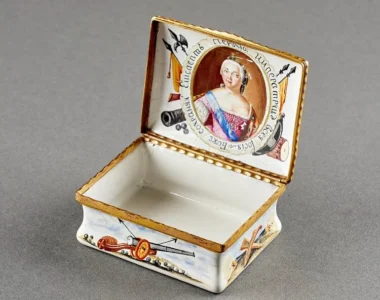
It became the first porcelain factory in Russia and one of the oldest in Europe. From the reign of Catherine the Great until 1917, every piece it made carried the monogram of the ruling monarch. For a century and a half it worked almost only for the court, and its porcelain rarely left the palaces.
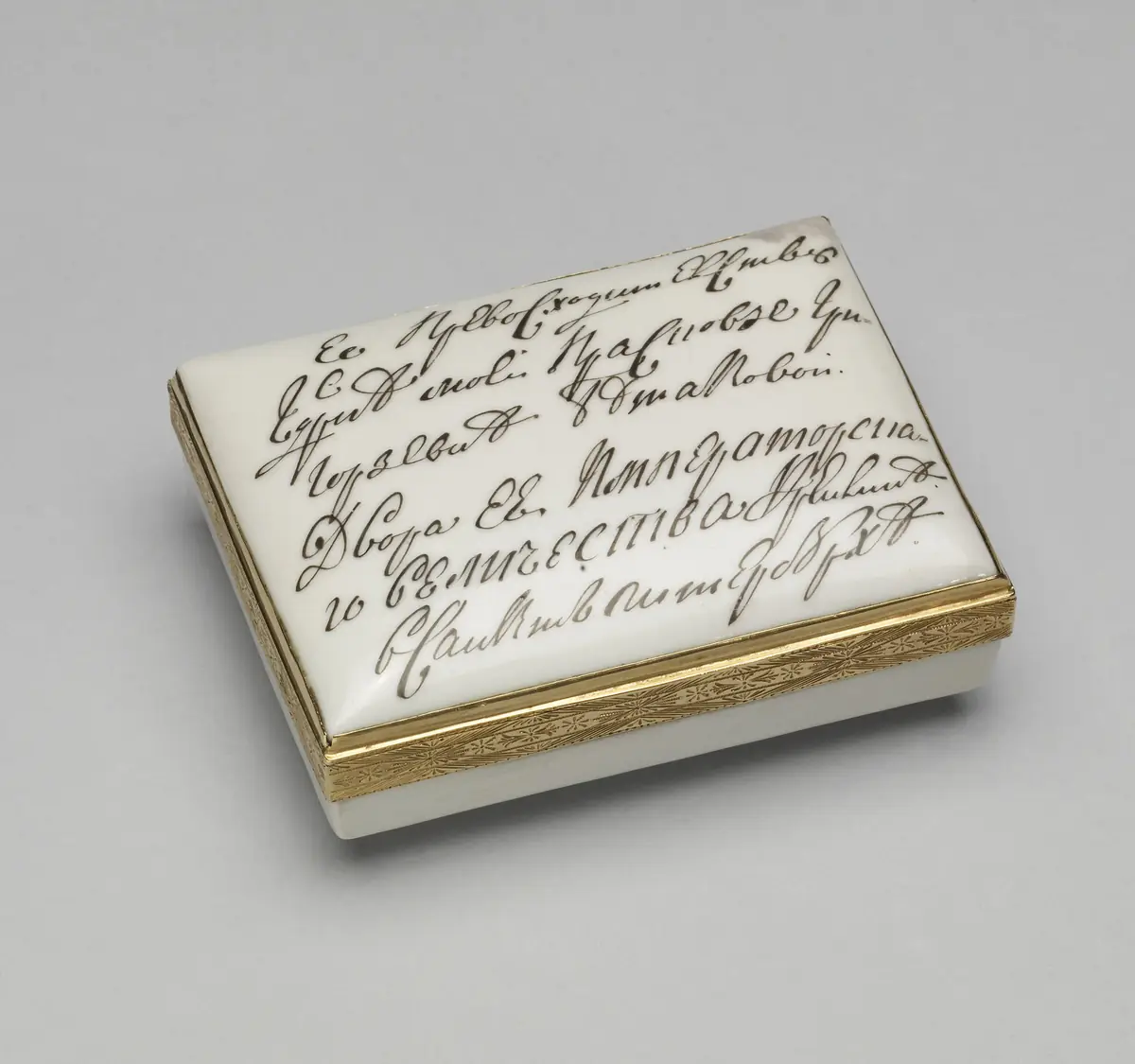
One such piece did cross the ocean, though a century and a half later. In the 1760s–80s the factory made a small porcelain snuffbox in the shape of a sealed letter, its lid painted as if addressed by hand to a lady of the court. Much later it was bought by Henry Walters of Baltimore (1848–1931), one of the great American art collectors, and it is now in the Walters Art Museum.
Imperial china at the department store
The real meeting came after the revolution. The new Soviet government needed foreign currency and began selling palace property abroad. Among the Americans doing business in Moscow in the 1920s were the brothers Armand and Victor Hammer, and in early 1932 they brought “Romanov treasures” to American shoppers.
The sale opened at Scruggs, Vandervoort & Barney, a department store in St. Louis. It went so well that the collection moved from city to city: Marshall Field’s in Chicago, Bullocks Wilshire in Los Angeles, then stores in Cleveland, San Francisco, Rochester, Pittsburgh and Washington. The biggest sale of all was held at Lord & Taylor on Fifth Avenue in New York, where, TIME wrote in the summer of 1933, imperial china and glass had been on show since the winter before.

Hammer made no secret of his method. He said he gave the sale “a healthy dose of snob appeal”. The price tags were embossed with the double-headed eagle, and the labels named the Winter Palace, Tsarskoe Selo and Gatchina. For most of the Americans who came, it was the first time they had seen porcelain from the tsars’ own factory, let alone been able to take a plate home.
Not every piece had the history its label promised. TIME reported that some of the factory’s china had been bought up in Moscow restaurants. Grand Duchess Marie, a first cousin of Nicholas II who was living in New York, recognised dishes from her own house in Petrograd among the pieces on show and went to court over them. The plates were sold one by one, not as whole services, and some can still be traced by their stickers. By the mid-1930s the brothers were selling from their own gallery at 682 Fifth Avenue, and its catalogue listed imperial porcelain as a category of its own.
An ambassador’s wife in Moscow
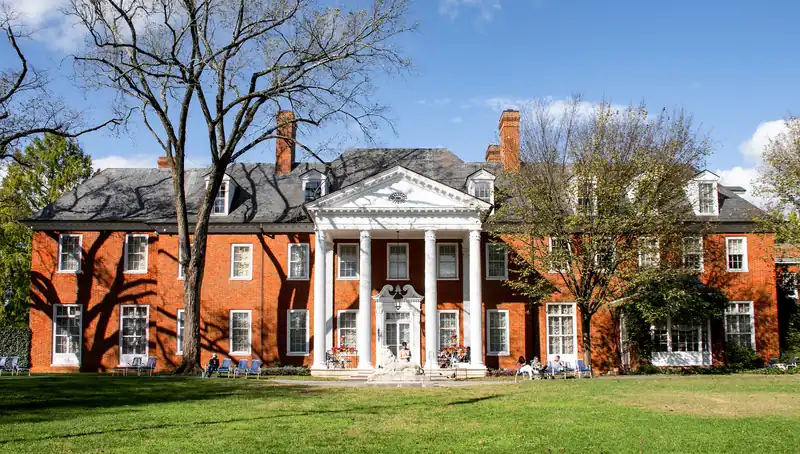
Marjorie Merriweather Post, heiress to the Post cereal company, arrived in Moscow in 1937 with her husband Joseph Davies, the new American ambassador. In 1937 and 1938 she bought porcelain, glass and silver in Soviet commission shops and state storerooms. Those purchases became the core of a collection she kept adding to for the rest of her life, mostly at American auctions.
Her Washington estate, Hillwood, is now a museum, and it describes its holdings as the most comprehensive collection of Russian imperial art outside Russia. Porcelain is the largest part of it, some sixty Russian dinner services. Post liked to use them: she had enough Russian and French tableware to set a table for more than 600 guests, and the museum still lays the dining table with Russian services, changing them through the year.
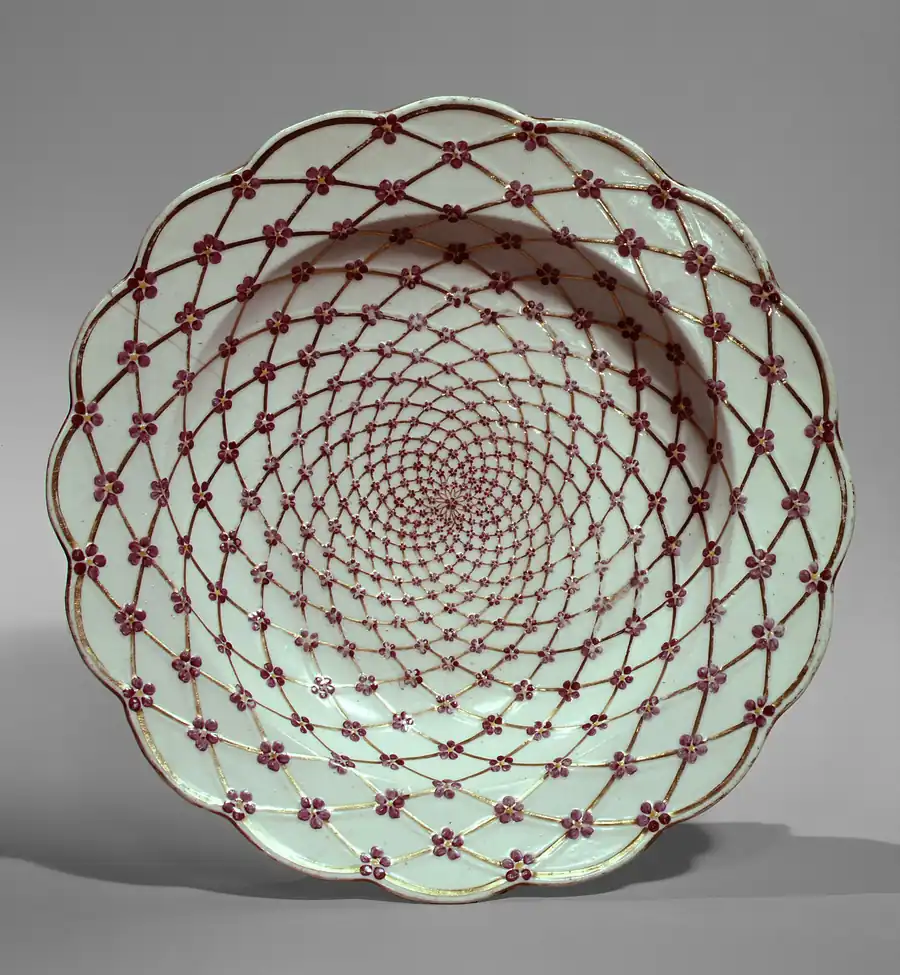
The Russian Porcelain Room at Hillwood holds a soup plate from Her Majesty’s Own Service, the very first service the factory made, for Empress Elizabeth in the late 1750s, and plates from the Kremlin Service of the nineteenth century. There is more about Post in our article Six Porcelain Gifts That Made History.
Revolutionary plates in American museums
The factory did not stop in 1917. As the State Porcelain Factory it spent the early 1920s painting slogans, workers and red stars, often on white imperial blanks left in its warehouses. At first the imperial mark on the base was covered up; later it was left as it was, so a revolutionary plate could carry the tsar’s cypher on the back. The government sent hundreds of these pieces abroad to exhibitions and fairs to earn hard currency, and some designs now survive only outside Russia. In 1925 the factory was named after Lomonosov, the name buyers abroad still know it by.
Americans took this porcelain seriously early on. In 1959 the Museum of Modern Art in New York received a saucer painted in 1923 by Nikolai Suetin, one of Kazimir Malevich’s closest pupils, marked “Lomonosov Porcelain Factory, Leningrad”. Henry and Ludmilla Shapiro, who worked as correspondents in Moscow from 1933 to 1973, brought home plates with slogans such as “Land to the Working People”; in 1989 their collection went to Cooper Hewitt, the Smithsonian’s design museum in New York. In 1992 the Art Institute of Chicago showed “News from a Radiant Future”, an exhibition of Soviet porcelain from the collection of Craig and Kay Tuber of Chicago.
A collector from Wisconsin
Some of the best American collections of the factory’s work were built by private people. Raymond Piper of Oshkosh, Wisconsin, began collecting imperial porcelain in the 1960s. In 2010–11 The Museum of Russian Art in Minneapolis showed about 140 pieces from his collection in “Dinner with the Tsars”, which followed the factory from Elizabeth to Nicholas II: plates from the Kremlin and Raphael services, and the porcelain Easter eggs the imperial family gave at Easter.
Another collection, gathered by Kathleen Durdin, toured the United States as “The Tsars’ Cabinet”. It brought more than 200 objects to American museums, among them many pieces from imperial services made by the factory, including two from the service Catherine the Great ordered for her grandson Grand Duke Constantine. In 2016 it was on show at the Reading Public Museum in Pennsylvania.
In 1996 Prince and Princess Alexander Romanoff, descendants of the imperial family living in America, gave the Metropolitan Museum of Art a plate the factory painted in 1796–1801 with a view of a Sicilian town square. Nearly seventy years after the Hammer sales, imperial porcelain was again passing from a Romanov to Americans, this time as a gift.
A pattern from 1944
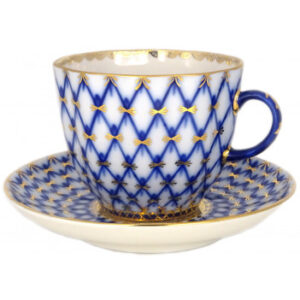
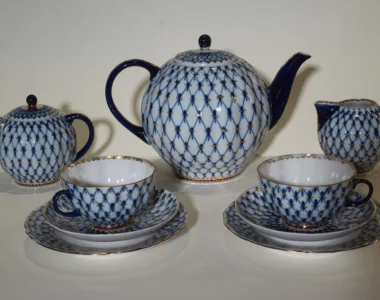
The design most people now connect with the factory is not imperial at all. In 1944, the year the siege of Leningrad was lifted, the artist Anna Yatskevich painted a cobalt-blue grid with gold on the Tulip tea set designed by the sculptor Serafima Yakovleva. Cobalt Net went into production in 1950 and won a gold medal at the Brussels World’s Fair in 1958.
A popular story says the grid recalls the paper strips criss-crossing Leningrad windows during the siege. Russian sources call this a legend with no documents behind it and point to a much older model: the net echoes Elizabeth’s Own Service, the factory’s very first. So the plate at Hillwood and a Cobalt Net cup on a breakfast table today share a common ancestor.
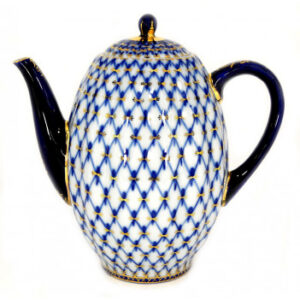
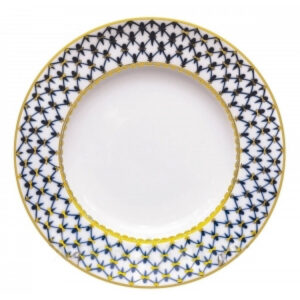
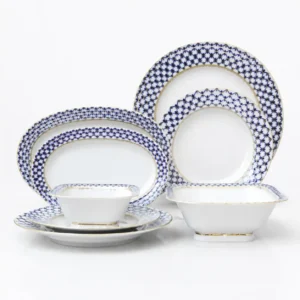
Cobalt Net now comes on more than 60 different pieces. It is the best-known Lomonosov pattern and the most copied one; here is how to tell a fake Cobalt Net from the real thing. Bone china came later: the factory made its first pieces in 1968.
Porcelain in the White House gift records
The factory’s work also appears among the official gifts received by American officials. In 2009 President Barack Obama and the First Lady received a tea set made at the Imperial Porcelain Factory, and in 2010 a pair of painted porcelain Easter eggs from the same factory. In 2012 Secretary of State Hillary Clinton received a Lomonosov tea set. All of them are listed in the official register the US government keeps of every gift it receives.
-
Pre-Order
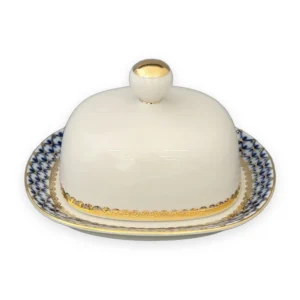
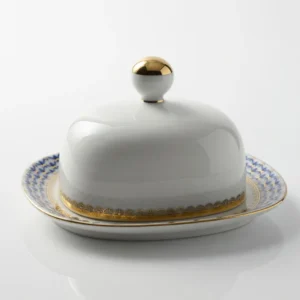
Butter Dish, 17.2 x 15.5 cm, Rectangular Shape, Cobalt Net Pattern
Available to pre-order, about 60 days
150.00 € -
Pre-Order

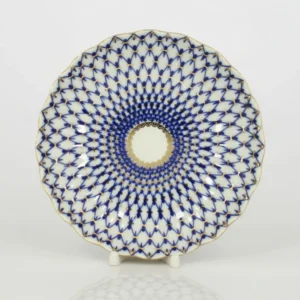
Cake Dish, 21.5 cm, Tulip Shape, Cobalt Net Pattern
Available to pre-order, about 60 days
190.00 € -
Pre-Order

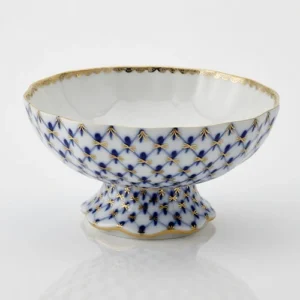
Candy Vase, 325 ml, Tulip Shape, Cobalt Net Pattern
Available to pre-order, about 60 days
180.00 € -
Pre-Order
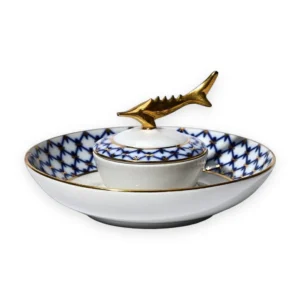
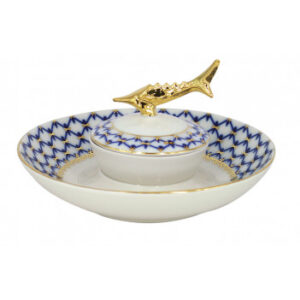
Caviar Dish, 65 ml, Caspian Shape, Cobalt Net Pattern
Available to pre-order, about 60 days
220.00 € -
Pre-Order
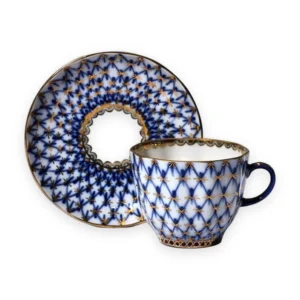
Coffee Cup and Saucer, 150 ml, Tulip Shape, Cobalt Net Pattern
Available to pre-order, about 60 days
90.00 € -
Pre-Order
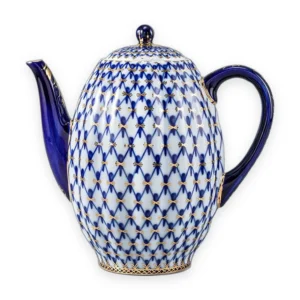
Coffee Pot, 1200 ml, Tulip Shape, Cobalt Net Pattern
Available to pre-order, about 60 days
350.00 € -
Pre-Order
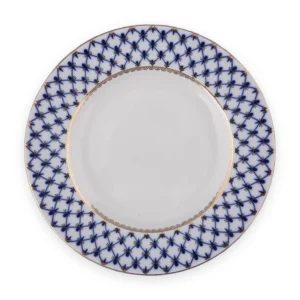
Dinner Plate, 24 cm, Smooth Shape, Cobalt Net Pattern
Available to pre-order, about 60 days
88.00 € -
Pre-Order

Dinner Set for 6, 24 Pieces, Youth Shape, Cobalt Net Pattern
Available to pre-order, about 60 days
2,200.00 €