


Porcelain has its own rules
Porcelain is more complicated than it looks. Every country has its own ideas about what makes an appropriate gift and what does not, and some of these traditions are far stricter than you might expect.
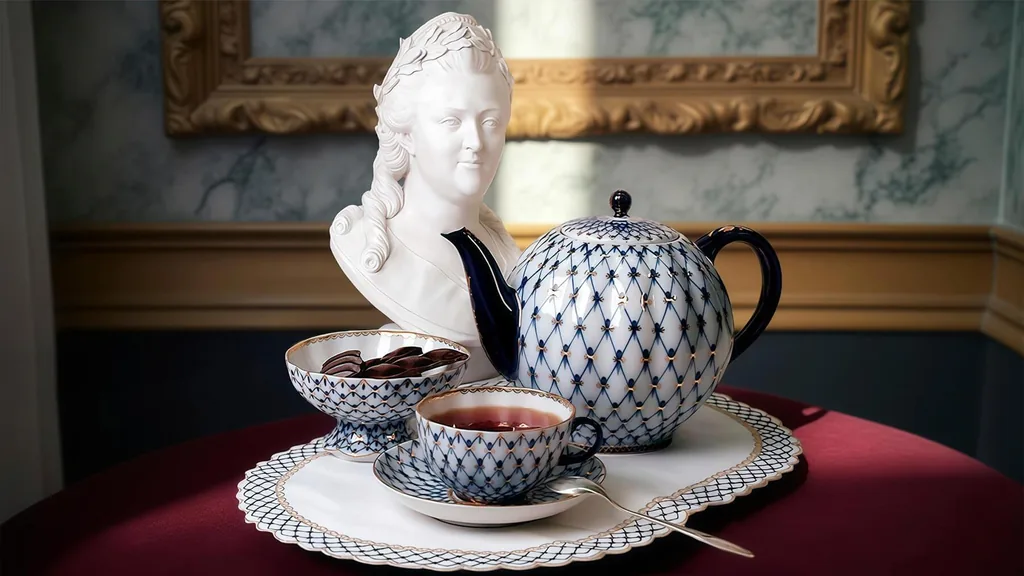
In England and Germany, a dinner service is traditionally given as a wedding gift. It is carefully preserved, brought out for major celebrations, and often passed down through the family. Twenty years of marriage is known as the porcelain anniversary: fragile, beautiful and increasingly valuable with age, porcelain makes a natural metaphor for a good, lasting union.
In China, pairing is especially important: a cup should go with its saucer, a teapot with its sugar bowl. A gift is not simply an object but a gesture that calls for a gesture in return, becoming part of etiquette, social ritual and mutual respect.
Japan has its own particular rules. Objects should harmonize not only visually but also in meaning and number. Particular attention is paid to counting, while white, a color associated with celebration in many cultures, carries a more complicated meaning there.
For all the variety of these traditions, porcelain has never been merely tableware. In different countries and different eras, it has been understood as a message: a statement about the giver's taste, their attitude toward the recipient, and the importance they attach to the gesture itself.
And when porcelain became part of state life, a gift could turn into a document of its time. Here are six stories that show just how much a piece of porcelain can carry with it.
1. The snuffboxes given out by an empress
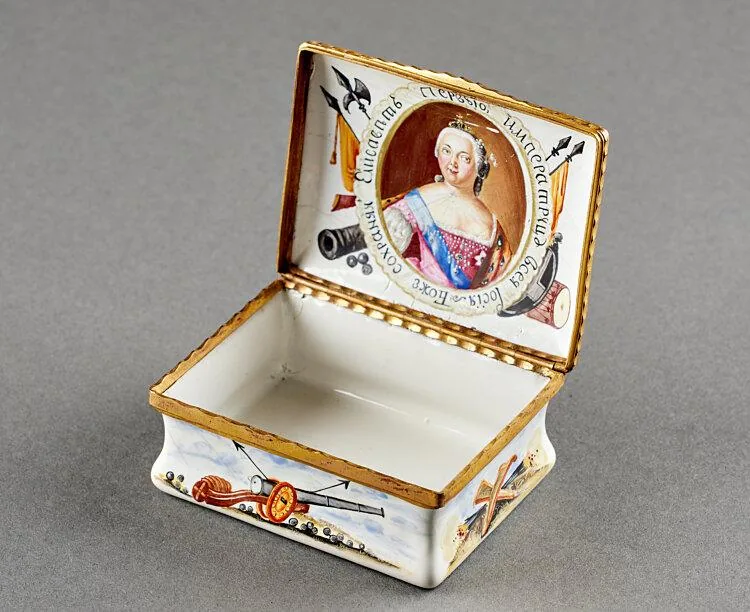
In the 1750s, the St Petersburg factory was only beginning to find its footing. Large and complicated pieces did not always come out well, but smaller objects such as snuffboxes were remarkably successful, making them one of the factory's first important products.
Empress Elizabeth Petrovna gave porcelain snuffboxes to her close associates and sent them with diplomats to European courts. They were small objects, but extraordinarily expensive and prestigious. Replicating them was almost impossible because, at the time, only a handful of European manufacturers knew the secret of porcelain production.
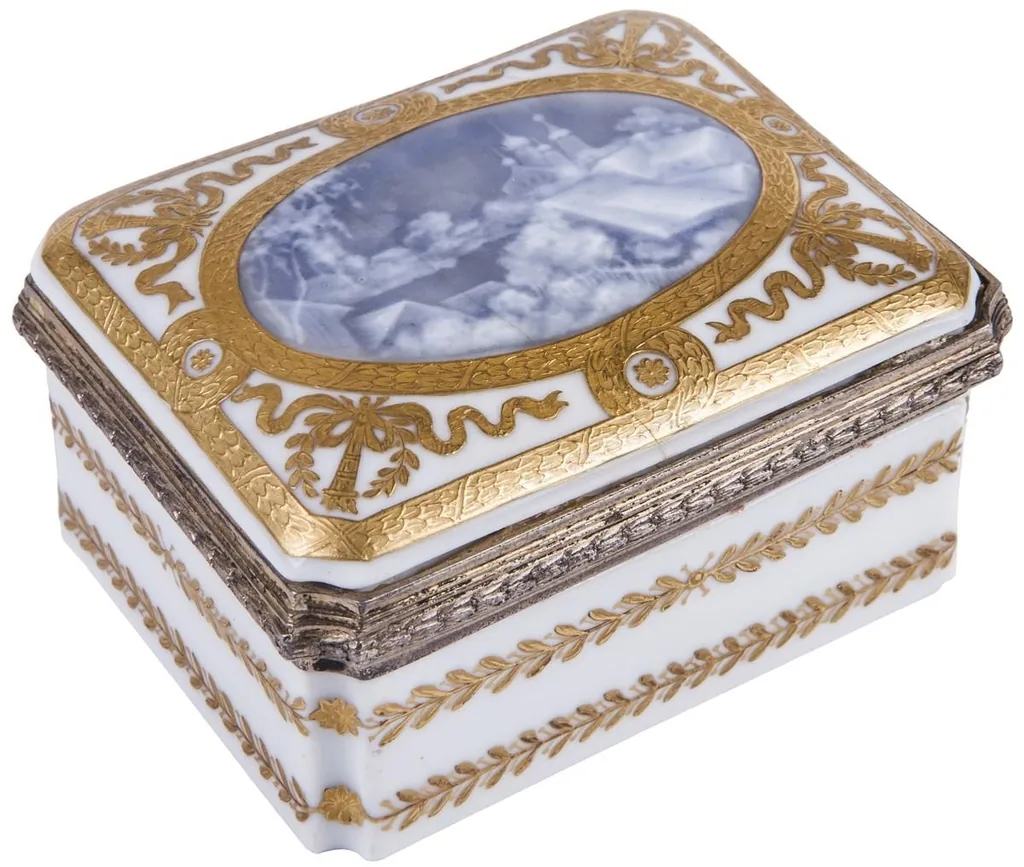
A snuffbox like this was more than an expensive accessory. It demonstrated the capabilities of Russian manufacturing while also telling everyone around its owner where it had come from. Its value lay not so much in its size or the amount of gold used, but in its rarity and the difficulty of obtaining anything comparable.
2. The dinner service that took longer to make than its owner lived
In 1793, Catherine II commissioned a dinner and dessert service for Count Alexander Bezborodko, her cabinet secretary and one of the most influential figures in the empire. The forms were restrained, while the decoration included gilded borders, garlands of wildflowers and medallions depicting scenes from classical antiquity.
The tableware was completed relatively quickly, by 1794. But the work did not end there. The service continued to be expanded, eventually reaching nearly a thousand pieces. Production stretched on for years and did not stop even after Bezborodko's death in 1799.
The gift was never actually presented to him. It remained in the imperial cabinet and later became known as the Cabinet Service. What began as a personal commission ultimately became a work of national and imperial significance.
3. The dowries that travelled across Europe
At the turn of the nineteenth century, the Imperial Porcelain Factory began producing ceremonial services for the daughters of Paul I, drawing in part on the famous Cabinet Service. They were intended as dowries and travelled with the young women to European courts.
Alexandra went to Austria, where she became an archduchess. Elena went to Mecklenburg-Schwerin. Maria went to Weimar, to a court closely associated with Goethe. Catherine first went to Oldenburg and later to Württemberg.
In this way, St Petersburg porcelain gradually became part of everyday life at several European courts. At dinners and receptions, it served as a reminder of the women who had brought it with them and of the court they had left behind. Unlike a diplomatic gift that might sit in a display case, a dowry became part of daily life and could preserve a sense of origin and family memory for generations.
4. The answer to Napoleon
In 1808, during the meeting at Erfurt, Napoleon presented Alexander I with a magnificent Egyptian Service from the Sèvres manufactory. The gift was designed to make an impression: at the time, Sèvres was one of Europe's leading porcelain manufacturers, and the service demonstrated the wealth and artistic ambitions of the French court.
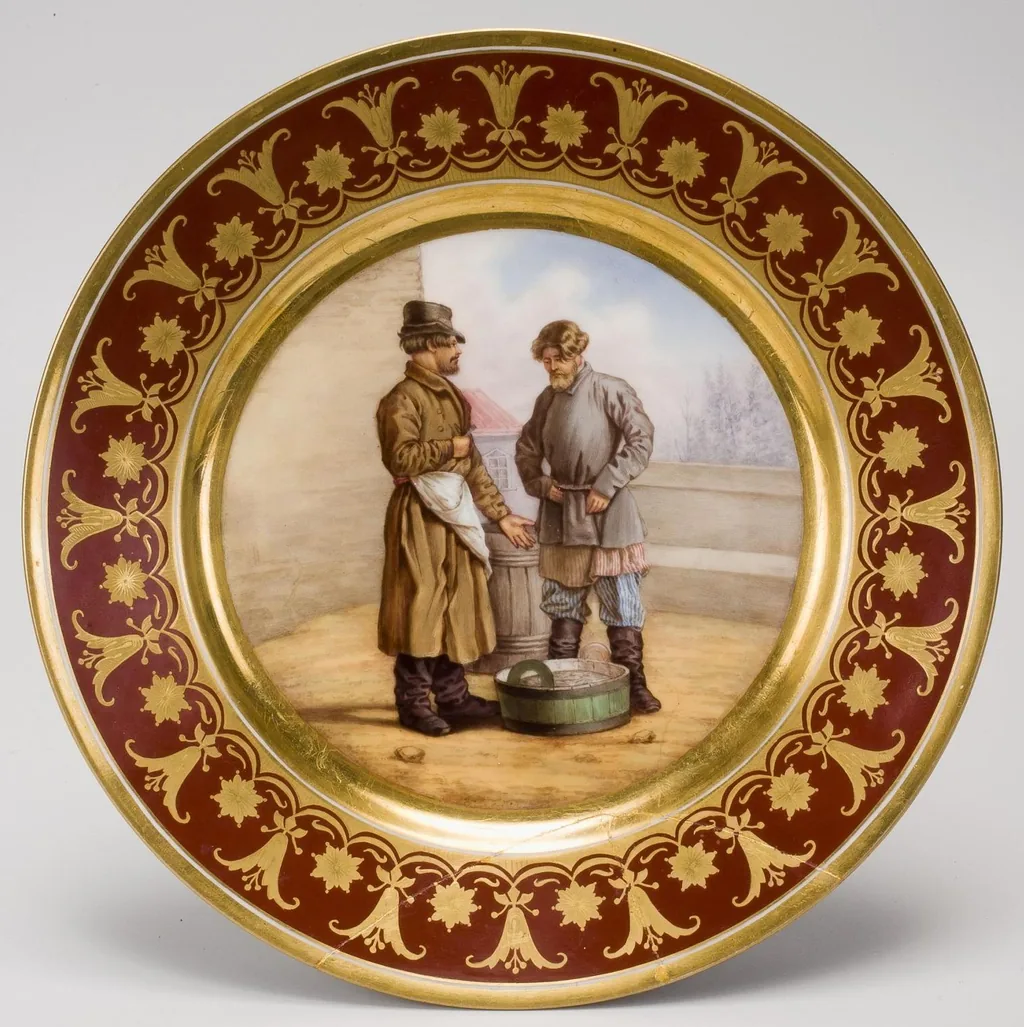
There was no easy way to respond immediately. A similarly ambitious imperial service would later be produced in St Petersburg. It became known as the Guryev Service, after the Minister of the Imperial Court: a ceremonial set for fifty people, decorated in red and brown tones with lavish gilding.
What makes the service particularly interesting, however, is not its size or cost but its imagery. Instead of military triumphs and allegories of victory, it featured scenes of Russian life, peasant subjects and views of St Petersburg, Moscow, Peterhof and Gatchina, based on drawings by Russian artists.
In response to a French display of imperial grandeur, Russia effectively presented an image of itself. The Guryev Service was used so extensively that additional pieces continued to be produced for it until 1917.
5. The vase that outlived two empires
In June 1844, Nicholas I travelled to England on a state visit and met Queen Victoria. It was the first visit by a Russian emperor to the country since Alexander I's trip in 1814, so the occasion carried considerable significance.
Among the gifts Nicholas brought to the British court was a presentation vase from the Imperial Porcelain Factory. It remained in Britain and is now part of the Royal Collection.
Almost two centuries have passed since that visit. Both empires have disappeared, states and borders have changed, and Russia and Britain have been allies and adversaries more than once. The vase, however, remains, preserving the memory of a meeting whose participants have long since passed into history.
6. The gifts that became a museum
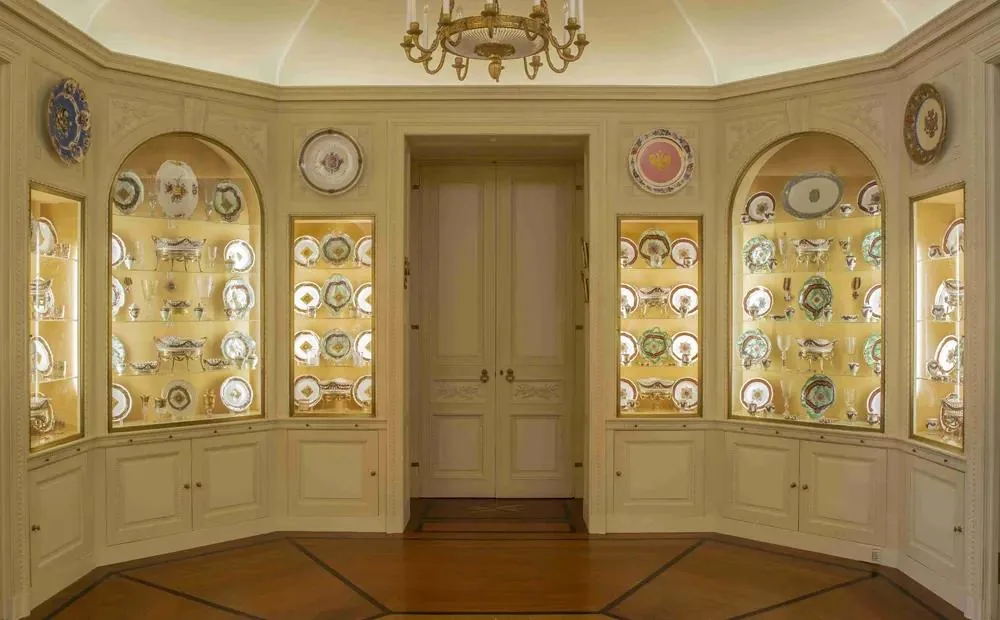
In 1937–1938, Joseph Davies was the US ambassador in Moscow. His wife, Marjorie Merriweather Post, accompanied him during their time in the Soviet Union. While there, she received Russian porcelain as gifts and also purchased a number of objects at a time when the Soviet government was selling parts of the imperial heritage abroad for foreign currency.
After returning from the USSR, Post continued collecting Russian art. She bought objects at auctions, through intermediaries and from owners of old collections, gradually building a collection that would eventually become one of the largest of its kind in the West.
Today, the collection is housed at Hillwood, a museum in Washington, DC. It includes dozens of Russian services, works by Fabergé and, among other treasures, an empress's wedding crown. The museum is open to the public and has become an important place for seeing Russian imperial art outside Russia.
It is a remarkably long historical chain: objects created in St Petersburg for the Russian court ended up in the hands of an American collector and, decades later, became part of a museum telling the story of Russian culture to people who may never have visited Russia.
What does it all mean?
Over two and a half centuries, attitudes toward gifts have certainly changed, but several things have remained constant.
- Rarity: what is difficult or impossible to obtain anywhere else tends to be especially valuable. The snuffboxes of Elizabeth Petrovna were expensive not only because of their materials and workmanship, but also because Russian porcelain itself was still a rarity.
- Presentation: the way a gift is presented matters enormously. Thousands of Easter eggs could be almost mass-produced objects, yet those handed directly to recipients by members of the imperial family became personal heirlooms.
- Longevity: a gift almost always outlives the circumstances in which it was given. The vase in Windsor has survived both the empire of Nicholas I and that of Queen Victoria, and the dowry services outlived their original diplomatic significance.
A good gift, then, is defined not so much by its price as by how clearly it reflects a choice. It can be expensive or modest, rare or produced in the thousands. What matters is that there is a reason it was chosen for that particular person. That is when an object stops being merely an object and begins to preserve the memory of a person, a time and the relationship in which it was given.
Giving a real piece of history to the people closest to you no longer takes a court, a diplomat or years of waiting — just the wish to do it.
Created at a historic manufactory with nearly three centuries of expertise in porcelain innovation.
-
 75.00 €
 -
 1,550.00 €
 -
 Preisspanne: 50.00 € bis 500.00 €