
In the hierarchy of applied arts, small forms often remain in the shadow of grand dinner services and monumental vases. However, intimate objects like jewelry boxes, snuffboxes, and bonbonnières reveal the true delicacy of porcelain. These items showcase the jeweler-like precision of the artists. Furthermore, the history of these items at the Imperial Porcelain Manufactory (IPM) chronicles the shifting aesthetic paradigms of Russia’s oldest ceramic enterprise.
Origins: Snuffboxes and 18th-Century “Gallantry Goods”
Dmitry Vinogradov founded the “Neva Porcelain Manufactory” in 1744. He faced the task of creating luxury items that matched the tastes of Empress Elizabeth Petrovna’s court.
During the 18th century, aristocrats considered snuffboxes and patch boxes (boîtes à mouches) essential accessories. Consequently, the IPM masters achieved incredible heights in relief technique and miniature painting. They often shaped boxes like pugs, mail packets, or shells. This approach perfectly matched the playful aesthetic of the Rococo.
- Artistic Feature: Artists often decorated the inner surface of the lid as intricately as the exterior. Thus, they hidden allegorical scenes or portraits for the owner’s eyes only.
The Golden Age of Classicism and Empire
The character of the boxes changed under Catherine II and Alexander I. Strict Classicism replaced the whimsical Rococo style. As a result, caskets of this time resemble ancient sarcophagi or architectural elements.
Representativeness became the priority during the Empire era. Therefore, masters made boxes more massive and used “tsirovka” (engraving on gold) extensively. Popular painting themes included:
- Views of St. Petersburg and suburban residences;
- Copies of paintings by great masters like Raphael or Guido Reni;
- War trophies and laurel wreaths.
Historicism and the 19th-Century “Russian Style”
An interest in national roots marked the second half of the 19th century at the IPM. Jewelry boxes began to imitate the shapes of ancient Russian chests. Moreover, decorators utilized the “painting like filigree” technique. This method imitated cloisonné enamel and made porcelain vie in beauty with gold and gemstones.
The Avant-Garde and 20th-Century “White Gold”
The factory became the State Porcelain Factory (GPF) after 1917. The new leadership radically reconsidered the concept of small forms. Consequently, the jewelry box transformed from a vanity item into an object of agitation or formal exploration.
Suprematist boxes by Kazimir Malevich and Ilya Chashnik represent a triumph of geometry. In these works, artists sacrificed functionality for architectonics. Meanwhile, Sergey Chekhonin used the surface of the boxes for complex graphic painting. He combined revolutionary symbols with the elegance of the “World of Art” style.
Modernity: Between Tradition and Artistic Expression
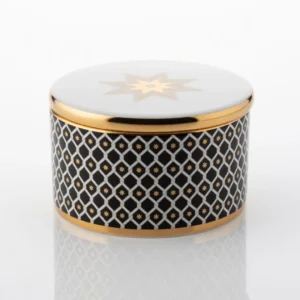
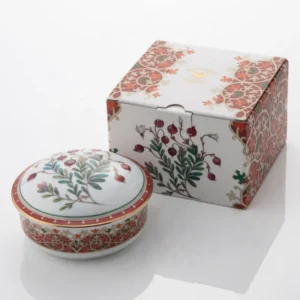
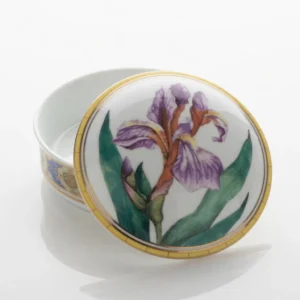
Today, the Imperial Porcelain Manufactory continues to produce jewelry boxes using its rich archive of forms. The contemporary range follows three main directions:
- Replicas of Historical Forms: These reproductions of 18th-century snuffboxes allow enthusiasts to experience “Vinogradov” porcelain.
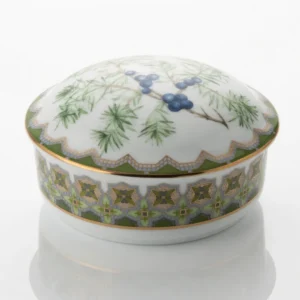
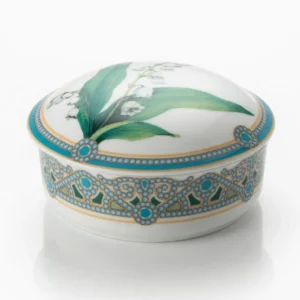
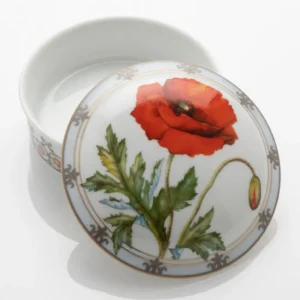
- Classical Painting: Caskets feature the traditional “Cobalt Net” by Anna Yatskevich or floral motifs like the “St. Petersburg Bouquet.”
- Artist Porcelain: Contemporary artists like Tatyana Afanasyeva treat the box as a small sculptural form. They often use underglaze painting and complex textures to enhance the work.
-
 140.00 € (112.90 € + VAT)
 -
 100.00 € (80.65 € + VAT)
 -
 100.00 € (80.65 € + VAT)
 -
 100.00 € (80.65 € + VAT)
 -
 100.00 € (80.65 € + VAT)
 -
 100.00 € (80.65 € + VAT)
